Electrical Inspection London: EICR & Testing You Can Rely On
An electrical inspection sounds like a formality until you actually need one, whether that’s because you’re a landlord with a legal deadline approaching, a buyer who wants reassurance before completing on a property, or a business that’s just been asked for evidence of compliance. First Strike Electrical Ltd has carried out electrical inspections across London since 1999, and as an NICEIC approved contractor, our inspectors are independently assessed against British Standard BS 7671, so the report you receive actually means something if it’s ever questioned by an insurer, local authority, or tenant.
The most common inspection we’re asked for is the Electrical Installation Condition Report, usually shortened to EICR, but we also carry out PAT testing (Portable Appliance Testing) and pre-purchase electrical checks. This page explains what each involves, who legally needs one, and what happens if problems are found.
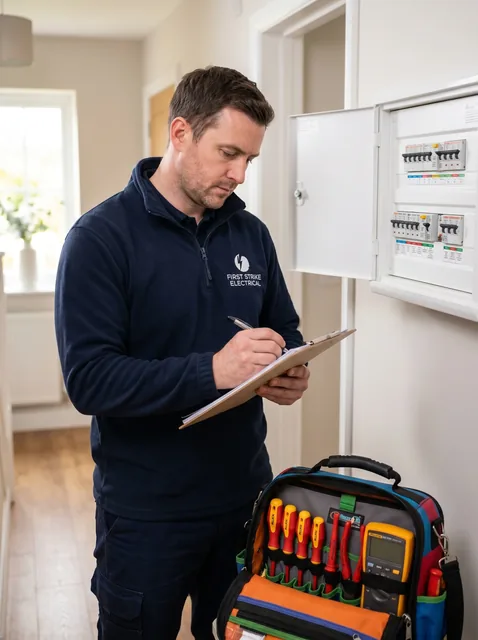
What Is an EICR, Exactly?
An Electrical Installation Condition Report is an assessment of the fixed electrical installation in a property, the wiring, consumer unit, sockets and fixed fittings, checked against the current edition of BS 7671 (the IET Wiring Regulations). It’s not the same as a Portable Appliance Test, which covers plug-in items like kettles and lamps, and it’s not the same as a Building Regulations Part P certificate, which is issued for specific notifiable work at the time it’s carried out.
An EICR is a point-in-time health check of the whole fixed installation, and it results in a report classifying any issues found by severity.
Danger present
Immediate risk to life. This requires immediate remedial action, sometimes on the spot, before the inspector leaves.
Potentially dangerous
Urgent remedial action is required, though not necessarily on the same visit.
Further investigation required
Something needs a closer look before it can be properly classified.
Improvement recommended
Not a legal requirement to fix, but brings the installation up to a more current standard.
For landlords specifically, current guidance is that C1, C2 and FI issues need to be organised for repair, replacement or further investigation within 28 days, with written confirmation of the completed work then provided to tenants and, where relevant, the local authority.
Who Legally Needs an EICR
Private landlords in England. Under the Electrical Safety Standards in the Private Rented Sector (England) Regulations 2020, private landlords must have the electrical installation in a rented property inspected and tested at intervals of no more than five years by a qualified and competent person. One valid certificate generally covers successive tenancies within that five-year window, so it’s not required for every new tenant, but the five-year clock doesn’t reset just because tenants change.
HMO landlords. Houses in multiple occupation frequently fall under licensing conditions that require more frequent inspection, often every three years rather than five, depending on the specific licence conditions set by the local authority.
Homebuyers and sellers. There’s no legal requirement here, but an EICR is one of the more useful things a buyer can commission before completing on a property, particularly anything older or where the seller can’t produce recent electrical certificates. It’s also increasingly requested by mortgage lenders and conveyancing solicitors as a condition of proceeding.
Businesses and commercial landlords. There’s no single blanket legal interval, but businesses have general duties under the Electricity at Work Regulations 1989 to maintain their electrical systems safely, and a periodic EICR, on a cycle appropriate to the type of premises and how it’s used, is the standard way of evidencing that duty to insurers, licensing authorities, and health and safety inspectors.
Why This Matters More Than a Box-Ticking Exercise
Enforcement around landlord electrical safety has been getting notably stricter. Financial penalties for breaches of the 2020 regulations were increased, with fines of up to £40,000 possible for the most serious breaches, and local authorities have been moving towards more proactive checks rather than waiting for a tenant complaint before acting.
Separately, an update to the wiring regulations, BS 7671 Amendment 2, has tightened technical requirements around areas such as surge protection and RCD selection, which means a property that passed comfortably at its last EICR can sometimes receive new observations at the next one, not because anything has got worse, but because the bar it’s being measured against has moved.
None of this is designed to catch landlords out unfairly, but it does mean leaving an EICR until the last possible moment, or assuming last time’s clean report will simply repeat itself, is a genuine risk.
What Happens During an Inspection
- 01
Booking and access.
We’ll arrange a time that works for you, or coordinate directly with a tenant if that’s more practical, with reasonable notice given either way.
- 02
Visual inspection and testing.
Our inspector examines the consumer unit, wiring, sockets, switches and fixed fittings, and carries out a series of electrical tests to check things that aren’t visible from the outside, such as earthing and insulation.
- 03
Classification of any findings.
Anything found is classified using the C1, C2, C3 or FI system described above, so you know exactly how serious each issue is, not just that “problems were found.”
- 04
The report itself.
You’ll receive a clear written report. If you’re a landlord, we’re happy to talk through what any codes actually mean before you pass the report on to a tenant or local authority, rather than you having to interpret it alone.
- 05
Remedial work, if needed.
Where issues need fixing, we can quote for the remedial work directly, or you’re free to use the report to get quotes elsewhere. Either way, once repairs are done, we can issue the follow-up certification confirming the installation now meets the required standard.
What an Electrical Inspection Actually Tells You
If you’re buying a property, particularly an older conversion or one that’s had no recent electrical work, an EICR gives you something a general survey usually won’t: a clear, classified picture of the condition of the wiring and consumer unit, rather than a general comment that “the electrics look dated.”
That can be genuinely useful for negotiating on price, planning a budget for remedial work after you move in, or simply deciding whether to proceed at all. If you’re selling, having a recent EICR ready, particularly a clean one, can pre-empt a buyer’s own inspection request and keep a sale moving rather than stalling while they arrange their own.
PAT Testing (Portable Appliance Testing)
PAT testing covers plug-in electrical appliances, kettles, computers, portable heaters, and similar items, rather than the fixed wiring an EICR assesses.
There’s no single fixed legal interval for PAT testing, but employers and landlords providing appliances have a general duty to keep equipment safe, and a risk-based testing schedule, more frequent for higher-risk equipment like items used in a commercial kitchen, less frequent for low-risk equipment like a desk lamp in an office, is the standard way of meeting that duty and demonstrating it if ever questioned.
For business premises, this often sits alongside the wider compliance work covered on our commercial electrician London page.
Why Choose Us for Your Electrical Inspection
NICEIC approved, so the report carries real weight. Because our work is independently assessed, a report from us isn’t just our own opinion of our own work, it’s backed by an external scheme with technical standards attached.
Plain-English explanations. A report full of C1s, C2s and clause references means little if nobody explains it. We’ll talk you through exactly what was found and what, if anything, needs doing, before you’re left staring at a document alone.
Fast, honest turnaround. We’ll give you a realistic timeframe for both the inspection itself and the written report, and stick to it.
Twenty five years assessing London properties. From Victorian conversions to modern new-builds, we’ve inspected enough different types of London housing and commercial stock to know what’s a genuine concern and what’s a normal quirk of an older installation.
No pressure to buy remedial work you don’t need. If we find something serious, we’ll tell you plainly. If we find something minor that can reasonably wait, we’ll tell you that too, rather than inflating every finding to justify more work.
Inspections Across London
We’re based in Marylebone, in the City of Westminster, and carry out EICRs and PAT testing for landlords, homeowners and businesses across central London and further into Greater London. For landlords or agents managing several properties, we can coordinate inspections across a portfolio on a rolling schedule, so certificates don’t all expire at once and catch you out.
Frequently Asked Questions
How often do I legally need an EICR as a landlord?
At least once every five years under the Electrical Safety Standards in the Private Rented Sector (England) Regulations 2020, though HMOs are often subject to shorter intervals, commonly three years, depending on licence conditions. The five-year clock runs from the date of the last inspection, not from when a new tenancy starts.
What happens if my EICR comes back with C1 or C2 codes?
Current guidance is that these need remedial action organised within 28 days, with written confirmation of the completed work then given to your tenant and, where relevant, your local authority. We can quote for the remedial work directly so it’s dealt with promptly.
How long does an EICR take?
It depends on the size and age of the property, but a typical residential EICR usually takes a few hours on site. We’ll give you a realistic estimate for your specific property when you book.
Do I need an EICR to sell my house?
It’s not a strict legal requirement to sell, but it’s increasingly requested by buyers, their solicitors, or mortgage lenders, particularly for older properties or where existing electrical certificates can’t be produced. Having one ready can also help a sale move faster.
Is a new EICR needed if my last one passed with no issues?
Yes, once the certificate reaches the end of its stated interval (generally five years for private rented residential property), a new inspection is needed regardless of the previous result. It’s also worth knowing that updated technical standards mean a property can occasionally pick up new observations even without any change to the installation itself.
Do you also do PAT testing, or just EICRs?
Yes, we carry out PAT testing for portable appliances alongside EICRs and other electrical inspection work. Let us know what you need when you get in touch and we can usually combine visits where that’s convenient.
Inspection and Testing in Detail
The individual testing services that sit alongside a full EICR.
We work across central, west, north west and south west London — see every area we cover.
Book an Electrical Inspection
Whether you’re a landlord working to a legal deadline, a buyer wanting peace of mind, or a business that’s been asked for evidence of compliance, get in touch and we’ll arrange an inspection and give you a clear, honest report.
NICEIC approved, trading since 1999.
First Strike Electrical Ltd