Commercial Electrician London Businesses Rely On
A commercial electrical fault doesn’t just cost you a repair bill, it costs you trading hours, staff time, and sometimes customer trust. First Strike Electrical Ltd has provided commercial electrical services across London since 1999, and as an NICEIC approved contractor, our work is independently assessed against British Standard BS 7671, giving you a level of accountability beyond a self-certified electrician. From a single office fit-out to ongoing planned maintenance across multiple sites, we work in a way that respects the fact that your electrics have to keep your business running, not just pass a test.
Commercial electrical work has different pressures to domestic work. You’re often working around trading hours, staff, customers, and sometimes strict compliance deadlines tied to insurance or licensing. We plan our work with that in mind, from scheduling noisy or disruptive jobs out of hours where needed, to keeping paperwork organised so you’re never scrambling to find a certificate when an inspector, insurer, or landlord asks for one.
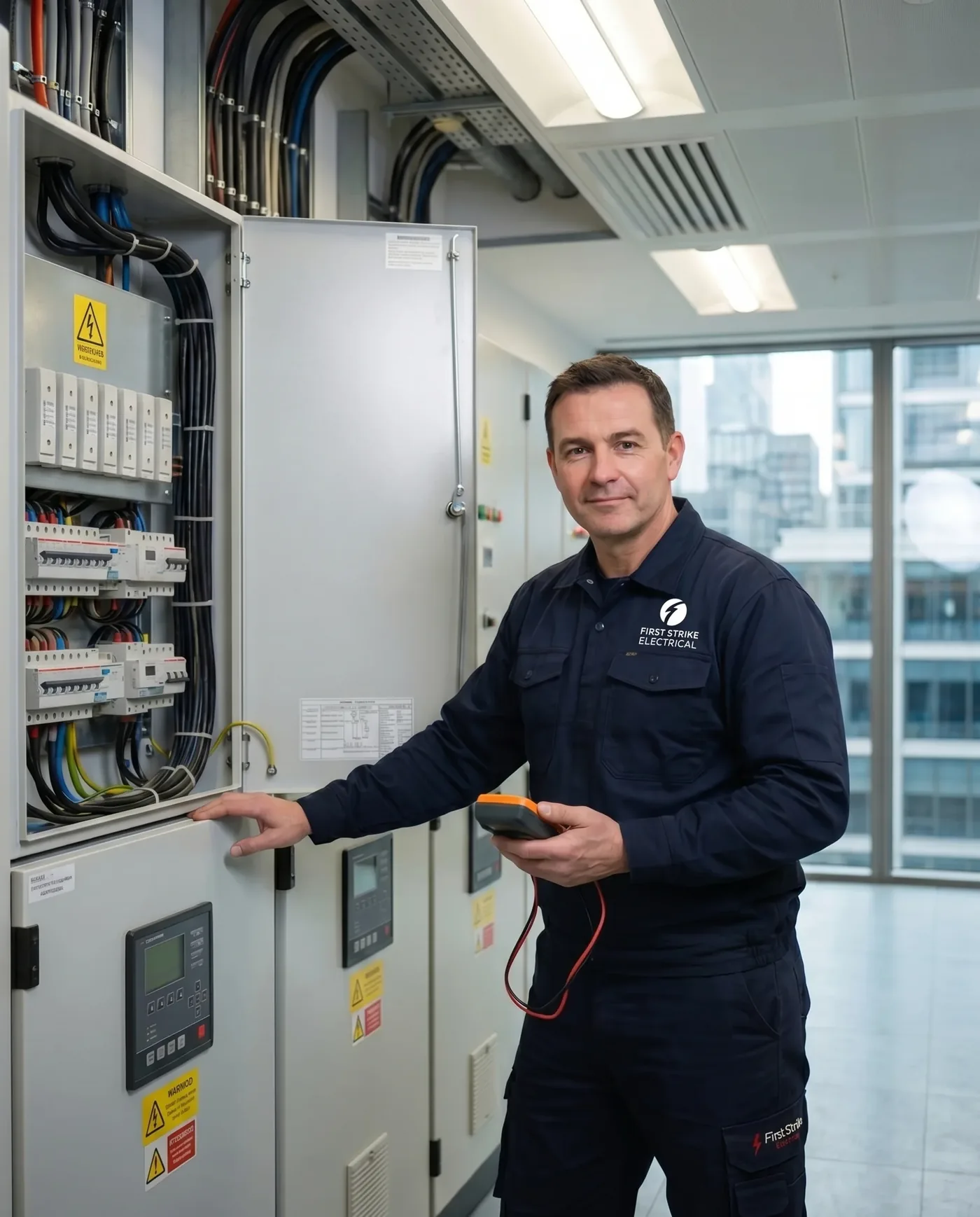
Commercial Electrical Services We Offer in London
Office and workspace fit-outs.
New office space, a refurbishment, or reconfiguring an existing layout: we handle the full electrical scope, including power distribution, data cabling coordination, lighting design, and testing, working alongside your other contractors and to your programme.
Retail and hospitality electrics.
Shops, restaurants, cafes and bars have their own specific demands, from display and feature lighting to kitchen equipment circuits and the electrical side of shopfitting. We understand that disruption during trading hours costs you money, and we plan around that wherever possible.
Three-phase power and higher-load installations.
Workshops, commercial kitchens, and industrial units often need three-phase supplies or higher-capacity circuits than a typical office. We assess your existing supply and advise honestly on what’s needed and why.
Fire alarm and emergency lighting testing and installation.
Under the Regulatory Reform (Fire Safety) Order 2005, the “responsible person” for a commercial building has a legal duty to maintain fire precautions, including emergency escape lighting, where a fire risk assessment says it’s needed. We install and test emergency lighting to BS 5266, covering both the monthly function test and the more demanding annual test, which confirms lighting stays illuminated for its full rated duration (typically three hours), and we can provide the logbook documentation you need to evidence compliance.
Data and network cabling.
Structured cabling for phone and data networks, often specified and installed alongside a wider fit-out or office move.
Planned preventative maintenance.
Rather than waiting for something to fail, a maintenance contract covers scheduled inspection and testing of your electrical installation, catching developing faults before they become costly downtime or, worse, a safety incident.
PAT testing for portable appliances.
While there’s no single fixed legal interval for portable appliance testing, employers have a general duty under the Electricity at Work Regulations 1989 to maintain electrical equipment in a safe condition, and a risk-based PAT testing regime is the standard way businesses demonstrate they’re meeting that duty.
Minor works and reactive repairs.
Not every commercial job is a big project. We also handle smaller reactive repairs, from a faulty circuit to a broken light fitting in a customer-facing area that needs sorting quickly.
Commercial EICR (Electrical Installation Condition Reports)
If you’re a commercial landlord, own business premises, or need to demonstrate electrical safety compliance for insurance, licensing, or a change of tenancy, see our dedicated electrical inspection London page for full detail on EICRs and testing intervals.
Sectors We Commonly Work With
Commercial electrical work varies a great deal by sector, and the specific compliance and layout demands of a restaurant kitchen are very different from those of a professional office or a warehouse.
We adapt our approach to the specific standards, licensing considerations, and operational pressures of each. If your premises falls outside these categories, get in touch and describe what you need. It’s easier for us to tell you honestly whether it’s a good fit than to guess from a general list.
Why Businesses Across London Choose Us
We plan around your trading hours, not the other way round. Where a job allows it, we’ll schedule disruptive work out of hours or in phases, so your business keeps running.
NICEIC approved, so your compliance paperwork stands up to scrutiny. Insurers, landlords, and licensing authorities increasingly want to see evidence of properly certified electrical work and testing, not just an invoice. Our certification is backed by an independent assessment scheme.
A single point of contact for multi-site businesses. If you manage several premises, whether that’s a small chain of shops or a portfolio of managed offices, dealing with one electrical contractor for testing, maintenance and reactive repairs is considerably simpler than juggling several.
Twenty five years trading in London. We’ve worked in enough different commercial settings, from Victorian shop conversions to modern glass-fronted offices, to generally already understand the electrical challenges specific to your type of premises.
Clear, upfront quoting. For planned work, you’ll get a proper quote before anything starts, broken down enough that you understand what you’re paying for.
Our Process for Commercial Jobs
- 01
Initial discussion.
Tell us about the premises, the work involved, and any constraints such as trading hours, access, or compliance deadlines.
- 02
Site survey.
For anything beyond a straightforward repair, we’ll want to see the site to scope the job properly and identify anything that might affect programme or cost.
- 03
Detailed quote and programme.
You’ll receive a clear quote and, for larger jobs, a proposed programme showing how work will be phased to minimise disruption.
- 04
Work carried out to plan.
Our electricians work to the agreed programme, keeping you updated if anything changes, and coordinating with your other contractors or staff where needed.
- 05
Testing, certification and handover.
Every job is tested and signed off, with the correct certification provided, including EICRs, minor works certificates, or emergency lighting test logbooks as relevant to the work carried out.
Keeping Your Business Compliant, Not Just Wired
Commercial electrical compliance isn’t a single certificate, it’s an ongoing responsibility. A fire risk assessment identifying the need for emergency lighting doesn’t stop being relevant the day it’s signed off. Monthly function tests and annual duration tests under BS 5266 need to keep happening, and keeping a logbook of the results is part of demonstrating you’ve met your duty as the responsible person under fire safety law.
Similarly, an EICR isn’t a one-off; commercial properties are generally recommended to be reassessed on a cycle appropriate to their use and any specific licensing requirements that apply.
We’re happy to set up a straightforward maintenance schedule that keeps these ongoing obligations on track, so compliance becomes a routine calendar entry rather than something you find yourself scrambling to sort out when an inspector, insurer, or new landlord asks for evidence.
Serving Businesses Across London
We’re based in Marylebone, in the City of Westminster, and work with commercial clients across central London, including offices, shops and hospitality venues in and around Fitzrovia, Mayfair and Paddington, as well as further out across Greater London for larger or multi-site jobs. For businesses managing several premises, get in touch to discuss how we can cover more than one address under a single arrangement.
Frequently Asked Questions
Do you work outside normal business hours?
Yes, where a job allows it, we’re happy to schedule disruptive work in the evenings, overnight, or at weekends to minimise the impact on your trading hours. Let us know your constraints when you get in touch and we’ll plan around them.
Is emergency lighting testing actually a legal requirement for my business?
If your fire risk assessment identifies a need for emergency escape lighting, then yes, maintaining and testing it is a legal duty under the Regulatory Reform (Fire Safety) Order 2005, with BS 5266 setting out the accepted monthly and annual testing regime. We can carry out this testing and provide the logbook evidence you need.
How often does my commercial premises need an EICR?
It depends on the type of premises and any specific licensing requirements, but commercial properties are generally reassessed on a set cycle recommended by the person carrying out the inspection. See our electrical inspection London page for more detail, or get in touch and we’ll advise on your specific premises.
Can you provide a maintenance contract rather than one-off callouts?
Yes, we can set up scheduled testing and maintenance visits so your ongoing compliance obligations, such as emergency lighting testing and periodic inspection, happen on a predictable schedule rather than being dealt with reactively.
Do you work on multiple sites for the same business?
Yes, and for businesses with several premises, having a single contractor manage testing, maintenance and reactive repairs across all of them is usually considerably simpler than coordinating multiple electricians.
What happens if you find a serious fault during testing?
We’ll tell you clearly what’s been found, how serious it is, and what needs to happen, including timescales, so you can make an informed decision about repairs rather than being handed a report full of codes you don’t understand.
Can you work around an active lease or during a fit-out with multiple other contractors on site?
Yes, this is one of the more common situations we work in. We’re used to coordinating with main contractors, project managers, and other trades on fit-outs and refurbishments, and we can attend site meetings or work to a shared programme where that’s how the project is being run.
Do you provide quotes in writing, and how detailed are they?
Yes. For any planned commercial work, you’ll receive a written quote setting out the scope of work, so you know exactly what’s included before you commit, rather than an informal verbal estimate that leaves room for disagreement later.
Insurance, Liability and Why This Matters for Your Business
When something goes wrong with commercial electrics, whether it’s a fire, an equipment failure, or a compliance breach flagged during a licensing inspection, the question of whether the work was carried out and certified properly is usually the first thing insurers and regulators look at. That’s true whether the original fault dates back years or was introduced last week.
Using an NICEIC approved contractor for your commercial electrical work, and keeping the resulting certification on file, is one of the more straightforward ways a business can protect itself, both practically and in terms of demonstrating due diligence if a claim or inspection ever arises. We’d always recommend keeping copies of every certificate and test logbook in a dedicated compliance folder, physical or digital, that’s easy to produce at short notice.
Commercial Services, Covered Individually
The specific pieces of commercial work we are asked about most often, each with its own page.
We work across central, west, north west and south west London — see every area we cover.
Discuss Your Commercial Electrical Requirements
Get in touch to discuss your premises, your compliance obligations, or an upcoming fit-out, and we’ll talk you through how we’d approach it.
NICEIC approved, trading since 1999.
First Strike Electrical Ltd